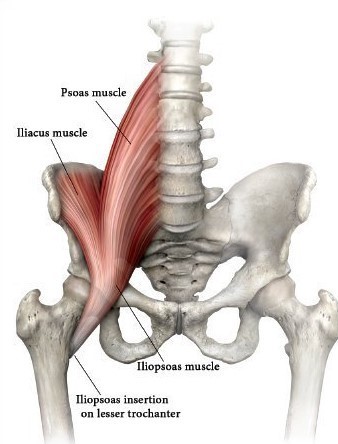

Hip flexion occurs at the hip joint, and involves bringing the leg forward/knee closer to the chest from a standing position. It is important in activities like running, walking, and kicking. The psoas muscle is listed as one of the primary hip flexors. It is considered by some in yoga circles to be the most important muscle in the body, because it connects the upper body to the lower (specifically the lower lumbar spine and pelvis to the legs). In trying to address my low back issues, I recall a chiropractor having me lie down on my back on a table, bring my knee up to 90 degrees, and resist as he tried to pull my leg down. Since I was able to exert a lot of resistance, he determined that my hip flexors were strong. The reason mine SEEMED strong is that one of the other primary hip flexor muscles is the rectus femoris (the green muscle pictured). This muscle is the superficial and outermost quad muscle and the only quad muscle that is a hip flexor since it has its origin on the upper front part of the pelvis (the others have their origin on the femur itself and are used exclusively for knee extension). I did a lot of squats at the gym and used to do some moderate distance running, and had very strong quads. But just because I was able to exert a lot of resistance did not mean that ALL of my hip flexor muscles were strong (or that all of my quad muscles were, for that matter… the quads consist of 4 different muscles). My rectus femoris was not only strong, but overdeveloped, while deeper muscles like my psoas (and iliacus, pictured) were actually weak. So only the superficial aspect of hip flexion was strong, hiding weakness in deeper muscles.
I give this as a simple and easy to understand example to show that muscle strength testing has its limits, and is not a precise science when trying to determine what muscles are weak. Almost every movement in the body utilizes multiple muscles working together. So an ability to exert resistance is not always a great way to hone in on weaknesses when some muscle or muscles that are part of a movement may be weak while compensating muscles can be strong enough to hide that weakness, even from a chiropractor or trained physical therapist.
 Asymmetrical Awareness